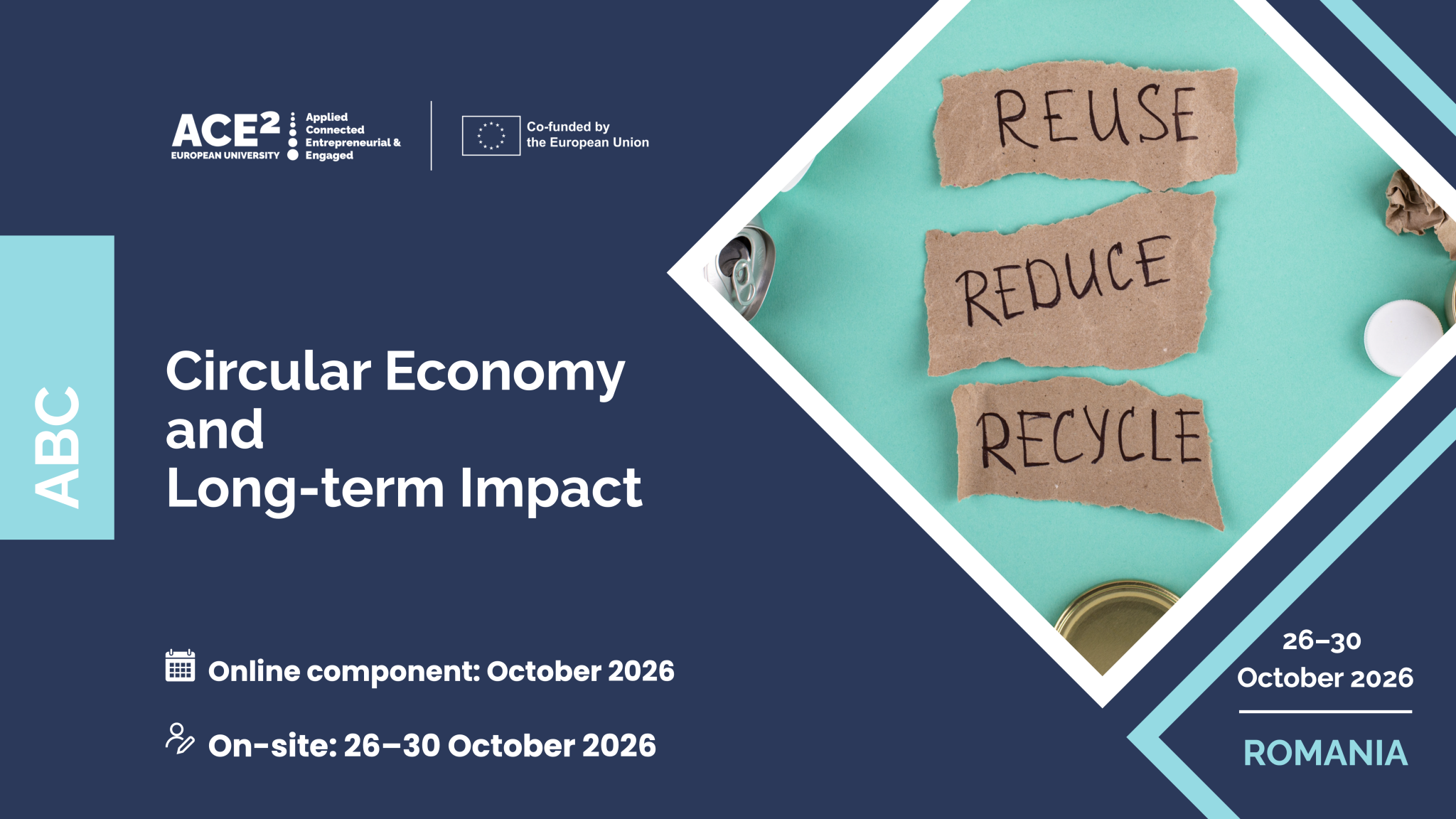
This course aims to help students understand how the current linear economic model contributes to environmental challenges and how it can be transformed into a more sustainable, circular system. Students will learn the key principles of the circular economy, including reducing waste, keeping materials in use, and designing products for longevity.
Throughout the course, students will develop a systems perspective, allowing them to analyse how resources flow through production and consumption processes. They will explore how products and services can be redesigned to minimize environmental impact and how businesses can adopt circular models that are both sustainable and economically viable.
The course also introduces tools for evaluating environmental performance, as well as the role of policies in supporting circular practices. In addition, students will reflect on the social and behavioural aspects of sustainability.
Organizer: Universidad Francisco de Vitoria - UFV
Country: Romania
Course Overview: This course provides an introduction to the principles, concepts, and practical applications of the circular economy and sustainability. Students will explore the environmental, economic, and social challenges associated with the traditional linear economic model and examine how circular economy strategies can contribute to sustainable development. The course covers key topics such as resource efficiency, waste prevention, sustainable production and consumption, product life-cycle thinking, eco-design, recycling, remanufacturing, and circular business models. Through case studies, interactive activities, and real-world examples, students will learn how organizations, governments, and communities are implementing circular solutions to address global sustainability challenges. By the end of the course, students will be able to analyze sustainability issues, evaluate circular economy practices, and propose innovative strategies that promote resource conservation, environmental protection, and long-term economic resilience.
Learning Outcomes: Define sustainability and the circular economy. Explain the differences between linear and circular economic models. Identify key circular economy strategies. Analyze real-world examples of circular business models. Evaluate the contribution of circular economy practices to sustainable development. Propose circular solutions for products, services, and organizations.
Skills Developed: Distinguish between linear and circular economic models. Analyze environmental, economic, and social impacts of resource use and waste generation. Apply life-cycle thinking to products and services. Identify opportunities for resource efficiency, reuse, repair, remanufacturing, and recycling. Evaluate circular business models and sustainable innovation strategies. Assess the contribution of circular economy practices to the Sustainable Development Goals (SDGs).
ECTS: 3
On-site Certificate Date: 30th of Nivember 2026
Working Package: WP2
On-site Course End Date: 30th of October 2026